

The 5 Areas of the Brain that Helps You Manifest
Have you ever wondered why no matter how much you journal or visualize, your old patterns keep showing up? Do you know what brain system is turning your repeated thoughts into automatic subconscious patterns?
What if the key to manifestation wasn’t just mindset—but actually how your brain wires itself?
I’m so glad you’re here today because we’re going to talk about something that sits right at the intersection of neuroscience and manifestation: the essential brain areas that play a role in reprogramming your subconscious and creating the life you truly desire.
I know that when most people think about manifestation, they imagine vision boards, affirmations, or journaling. And while those tools are powerful, what’s happening underneath—inside your brain—is what really drives lasting transformation.
Remember as I have mentioned many times: we don’t manifest or create the life we desire from our thoughts, we manifest or create it from our subconscious self worth.
Understanding this gives you not only a sense of empowerment but also clarity that you’re not just “hoping” for change—you’re literally rewiring your brain.
So today, I’m going to walk you through the key brain areas that work together in this process. Don’t worry, I’ll keep the science easy to understand, and at the end, I’ll give you some practical reflections and tips you can use right away.
- The Pre-frontal Cortex
- The Limbic System
- The Reticular Activating System
- The Basal Ganglia
- The Default Mode Network
- How it All Works Together
- Activate Your Brain: 5 Practices to Create Your Aligned Life
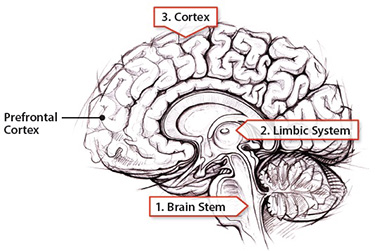
Let’s get started by understanding the 5 key brain areas that work together in this process
The Prefrontal Cortex – The Executive Center
This area is located right in your forehead area and you can think of the prefrontal cortex, or PFC, as the CEO of your brain. This is where conscious thought, reasoning, planning, and focus happen. And the PFC typically finishes developing and matures fully around age 25. This is key to understand our kids and teenagers emotional responses and impulsivity. If you are a parent, you know what I’m talking about!
In manifestation, your PFC is active when you:
- Set intentions – defining what you truly want.
- Visualize – imagining that future reality as if it’s already happening.
- Prioritize – keeping your long-term goals front and center, instead of getting lost in short-term distractions.
- Manage self-talk – consciously choosing empowering thoughts instead of looping in old, negative patterns.
So every time you pause to write down a clear intention, or gently redirect a negative thought into an empowering one, you’re strengthening this executive part of your brain.
The Limbic System – The Emotional Amplifier
The limbic system is your emotional brain. This is where memories, emotions, and motivation live.
- The amygdala, which is the part of your brain that acts like a tiny, almond-shaped “alarm system” for danger, attaches emotional “charge” to your experiences. When you visualize your future with joy, gratitude, or excitement, you’re literally making those images stickier for your brain.
- The hippocampus, which is a tiny, seahorse-shaped part of your brain that acts like a memory filing cabinet, links these imagined scenarios with memory, so your brain starts treating them as familiar instead of distant “what ifs.”
- And the limbic system is tied to dopamine, the feel-good neurotransmitter, that I have been mentioning several times in this podcast. Anticipating your goals releases dopamine, which motivates you to keep going.
This is why emotions are the fuel of manifestation. It’s not just about thinking—it’s about feeling it as if it’s already real. Ive told you before that the Feeling is the Secret. Actually if you go to my amazon storefront, you can find Neville Goddards book called The Feeling is the Secret. Do me a favor and buy it, it will be the best $7 you will spend.
The Reticular Activating System – The Filter
The RAS, this network of neurons located in your brainstem, is like the bouncer at the door of your mind. It filters what information gets your attention.
Here’s a simple example: You decide you want a certain car, and suddenly, you see that model everywhere. Did the cars magically appear? No— the cars were there all this time, however the RAS started flagging that information as important.
The same is true for your goals. When you focus intently on something, the RAS helps you notice opportunities, resources, and people that align with that goal. It bridges conscious focus and subconscious attention.
The Basal Ganglia – The Habit Maker
If the prefrontal cortex is the CEO, the basal ganglia are the operations team. The basal gangla is a group of subcortical structures that form an interconnected network within the brain. Listen, don’t worry or get to hung up on the science, at the end of the day, we are here to understand this concepts as easy as we can so we can create the awareness, when we are working to get into alignment and manifest.
This area automates behaviors—both physical and thought-based.
- Practice a new habit long enough, and the basal ganglia takes over, so it becomes second nature.
- This applies to mental habits too. Affirmations, mantras, or even simply replacing “I can’t” with “I’m learning to” becomes easier and automatic over time.
This is how subconscious reprogramming actually takes root—repeated thoughts and behaviors shift from effortful to effortless.
The Default Mode Network – The Inner Dreamer
Oh My God! this brings me back memories of my professor Gregory, when I was getting my certification as a Neuro-Coach. He had the most funny and crazy ways of teaching us this concept. And what he said was: Think of it as your brain’s internal, often silly, “what if?” engine, responsible for daydreaming, reminiscing about that embarrassing thing you did last year, ruminating and even coming up with those random shower thoughts that lead to brilliant ideas. Yes this was how my teacher explained this.
So…This network is most active when you’re daydreaming, self-reflecting, or simply at rest.
It’s involved in:
- Self-reflection – creating your sense of identity.
- Creative rehearsal – imagining scenarios, playing with “what ifs.”
The DMN is powerful for manifestation because it integrates your visualizations and reflections at a subconscious level—even when you’re not actively trying. This is why those quiet moments of journaling, meditation, or even just letting your mind wander are so impactful. Are you doing any of these practices? Friend, what are you waiting for….nothing changes if nothing changes.
Now that we have an understanding of how each area works by itself, lets find out:
How It All Works Together
So here’s the magic:
- The PFC sets your intentions and plans.
- The limbic system adds emotion, making those intentions sticky.
- The RAS filters reality to bring opportunities into your awareness.
- The basal ganglia automates the supportive habits.
- The DMN integrates all of this beneath the surface while you rest.
And together, through my favorite concept of all times….neuroplasticity—the brain’s ability to rewire itself—you are literally reshaping your mind to support your new reality.
Talk about bringing the science to a concept that has being judged as woo woo for a long time. Now you know its not abstract, it is very very clear.
Now, let’s bring this down to earth all of this information with some daily practices you can start using: Get your pen and paper because I will give you 5 ways to do this.
Activate Your Brain: 5 Practices to Create Your Aligned Life
- Intention Journaling – Each morning, write one clear intention. Keep it simple: “I am creating more peace in my relationships” or “I welcome opportunities for abundance.” And listen if you want go back to last week episode about Neuro-Align journaling where I give you a more detailed flow on how to do this
- Emotional Visualization – Spend 2–3 minutes not just seeing, but feeling your desired outcome. Ask: What emotions would I feel if this were already true?
- Filter Training – Choose one symbol or word connected to your goal and notice how often it shows up. This engages your RAS to filter your environment. If you want to truly understand the RAS, you must listen to Episode 23.
- Habit Anchoring – Attach a new habit to an existing one. For example, every time you brush your teeth, repeat a mantra like “I trust the process of my life.” and make sure you are looking into your eyes in the mirror white you mentally repeat this.
- Restful Integration – Give yourself moments of stillness—no phone, no distractions. Let your DMN process and integrate. I was talking to my husband about this. It is so important to take a pause daily. We live in a time where we are constantly bombarded. Information overload my friend! So taking a pause at the beginning, middle and end of the day is key.
I have a couple of Reflection Questions for You:
Which of these practices feels most aligned with where you are right now? How can you start practicing it this week?
What part of your brain have you been unknowingly activating the most? Has it been the part that loops in old patterns—or the part that’s ready to create new ones?
What’s one small thought, one emotion, or one habit you can choose today that will move you closer to the reality you desire?
Remember—every single choice, every intentional practice, is a signal to your brain. You’re teaching it what to prioritize, what to automate, and what to believe is possible for you.
Share with me your findings and insights, it helps me to keep creating episodes that you like. You can share by following me on instagram at michellemariepacheco, and send me a DM there.
Remember, manifestation isn’t about forcing outcomes—it’s about aligning your conscious focus and subconscious patterns so your brain naturally begins supporting the life you’re calling in. And the beautiful truth is: your brain is always listening, always reshaping. So start whispering to it the story you actually want to live.
I hope this article gave you not just the “what” but also the “why” behind the brain science of manifestation.
If this resonated with you, I’d love for you to share it with someone who’s on their journey too, and since this is PODCAST EPISODE 43, make sure to leave me a podcast review. It is the easiest way you can support my work.